
How to Build a Consistent Study Habit: The Streak Method That Actually Works
Learn the science-backed streak method to study every day. Discover why tracking consecutive days beats tracking hours, and how a 5-minute minimum can transform your study routine.
You’ve told yourself “I’ll study every day starting Monday” at least a dozen times. Monday comes, you study for two hours, feel great. Tuesday you do an hour. Wednesday something comes up. By Thursday, the plan is dead.
Sound familiar? You’re not alone — research shows that 83% of students fail to maintain consistent study routines beyond the first week. The problem isn’t motivation, intelligence, or willpower. The problem is the method.
This guide introduces the Streak Method — a psychology-backed approach that replaces ambitious schedules with a simple daily chain. It’s the same principle Jerry Seinfeld used to become one of the greatest comedians alive, adapted for academic success.
Why Most Study Plans Fail
Before building a better system, let’s understand why traditional approaches break down.
The “2 Hours Every Day” Trap
Setting an ambitious daily goal feels productive when you write it down. But high targets create a psychological barrier — on tired days, the thought of sitting down for two hours feels overwhelming, so you skip entirely. One skip becomes two, and the habit never forms.
All-or-Nothing Thinking
“I already missed yesterday, so what’s the point?” This cognitive distortion kills more study plans than anything else. When you define success as perfection, a single miss feels like total failure.
No Visual Feedback
Studying without tracking is like exercising without a mirror or scale. You have no evidence of progress, no accumulation to protect, and no reason to show up beyond abstract future benefits.
Willpower Depletion
Willpower is a finite resource. Relying on it to force yourself to study every day is like running a marathon on one meal — you’ll collapse before the finish line.
The core insight: Consistency beats intensity. Studying 15 minutes every day for a month produces better results than studying 5 hours in one weekend.
The Streak Method: A 5-Step System
Step 1: Set an Absurdly Low Daily Minimum
Here’s the counterintuitive foundation: your daily minimum should be 5 minutes.
Not 30 minutes. Not an hour. Five minutes.
Why? Because the hardest part of studying isn’t the studying — it’s the starting. Once you sit down and open your materials, you’ll almost always continue past the minimum. Research on “implementation intentions” by psychologist Peter Gollwitzer found that defining a specific, low-barrier action increases follow-through by 2-3x compared to vague goals.
The 5-minute minimum removes the psychological barrier entirely. Even on your worst day — exhausted, sick, stressed — you can study for 5 minutes. And that’s enough to keep the chain alive.
What actually happens: Most people who sit down for “just 5 minutes” end up studying for 20-40 minutes. The minimum isn’t the goal — it’s the trigger.

Remember: The goal isn’t to study for hours — it’s to never have a zero day. Even 5 minutes keeps the chain alive.
Step 2: Track Consecutive Days, Not Total Hours
This is the key shift. Instead of logging hours, count how many days in a row you’ve studied.
The concept comes from what’s known as the “Seinfeld Strategy.” Jerry Seinfeld’s advice to aspiring comedians was simple: write jokes every day and mark each day with a big red X on a wall calendar. After a few days, you have a chain. “Don’t break the chain” becomes the only rule.
Why does this work? Three psychological mechanisms:
Loss aversion. Nobel laureate Daniel Kahneman demonstrated that losses feel roughly twice as painful as equivalent gains feel good. A 15-day streak becomes something you own — something to lose. The longer the streak, the stronger the motivation to protect it.
Visual momentum. Seeing a chain of completed days creates tangible evidence of progress. Unlike vague feelings of “I should study more,” a 20-day streak is concrete proof that you’re someone who studies every day.
Identity shift. As James Clear describes in Atomic Habits, every completed day is a vote for the identity “I am someone who studies daily.” Over time, the behavior becomes part of who you are, not something you force yourself to do.
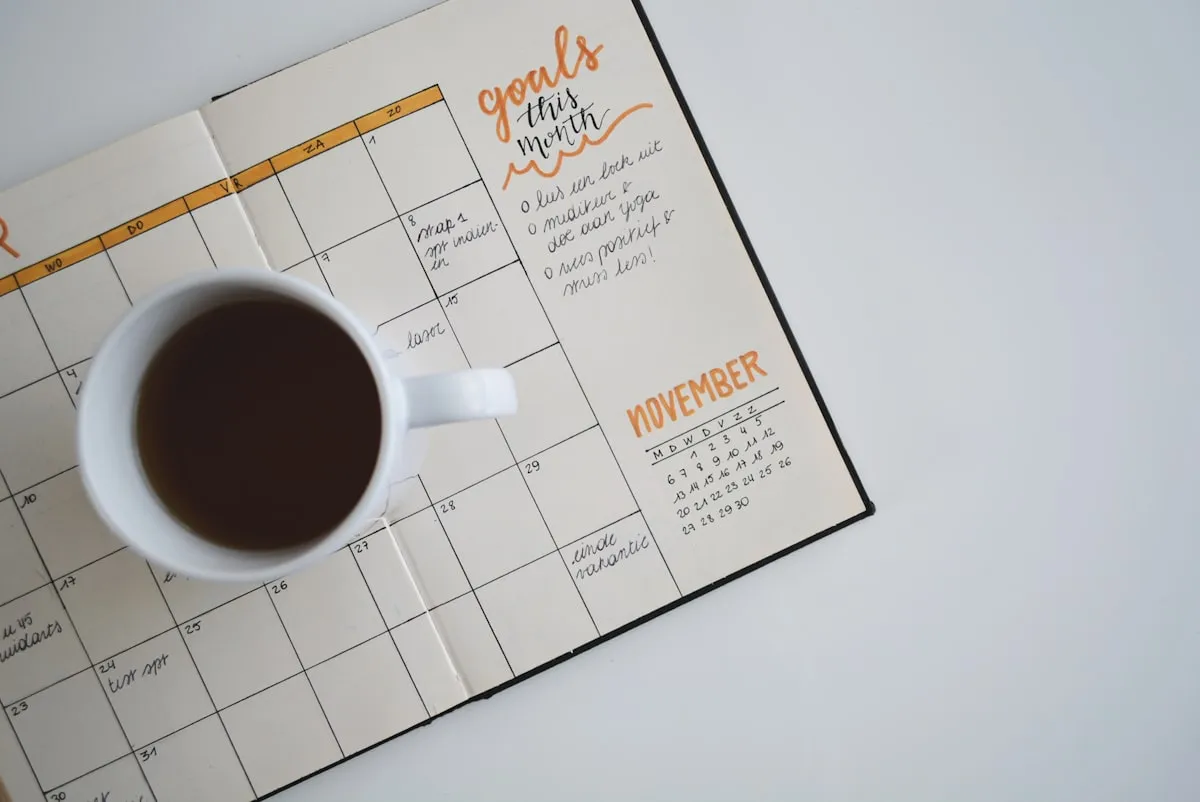
Step 3: Use a Visual Calendar
The format matters. A monthly grid calendar where you check off each day is significantly more effective than a simple number counter.
Why? Spatial representation creates a stronger psychological imprint. Seeing a grid with 18 out of 30 boxes filled — and a gap on day 12 — tells a story. The filled squares feel satisfying; the empty ones feel incomplete. Your brain wants to fill the grid.
This is the Zeigarnik Effect in action — our brains are wired to remember and feel tension about incomplete tasks. An incomplete calendar row nags at you (in a good way).
Physical vs. digital: Both work. A paper calendar on your wall provides constant visibility. A digital tracker like FocusCroc adds smart features — automatic tracking, streak statistics, and backup if you lose the paper.
Step 4: Build in a Safety Net
Here’s where the Streak Method diverges from rigid approaches: allow yourself to miss one day without losing your streak.
This sounds counterproductive, but research supports it. Phillippa Lally’s landmark 2010 study at University College London found that missing a single day did not meaningfully affect habit formation — as long as the person resumed the next day.
The “streak shield” concept works like this: you get one protected day per streak cycle (e.g., per week or per month). If life genuinely prevents you from studying, you can use the shield to preserve your streak. Paradoxically, knowing the safety net exists reduces the likelihood of using it — the pressure to be “perfect” is gone, which removes the anxiety that often causes people to quit entirely after one miss.
Step 5: Set an Evening Nudge
Timing matters. A gentle reminder at 9:00-9:30 PM — before your day ends but late enough that you’ve handled other responsibilities — creates a last-chance trigger.
The key is tone. Not “YOU HAVEN’T STUDIED TODAY” but something like “5 minutes before bed? Your 14-day streak is waiting.” It should feel like a friendly nudge, not a guilt trip.
Research on notification timing suggests that evening reminders are most effective for habit completion because they create a clear “now or never” decision point before the day resets.
What Real Progress Looks Like
The Streak Method doesn’t produce overnight transformation. Here’s a realistic timeline:
| Week | What Happens |
|---|---|
| Week 1 | You study 5-10 minutes most days. It feels too easy. |
| Week 2 | Sessions naturally extend to 15-25 minutes. The streak starts to feel valuable. |
| Week 3 | You catch yourself studying even when you don’t feel like it — because you don’t want to break the chain. |
| Week 4+ | Studying feels automatic. Average sessions reach 30+ minutes. You’ve built an identity. |
The compound effect is remarkable. Even at the minimum — 5 minutes daily for 30 days — that’s 2.5 hours of studying that simply wouldn’t have happened with a “study 2 hours on weekends” approach that falls apart after week one.

Tools for the Streak Method
Paper Calendar (Free)
A simple monthly calendar on your wall works surprisingly well. Buy a marker, cross off each day. The physical act of marking has its own satisfaction.
Pros: No battery needed, always visible, deeply satisfying to mark. Cons: No statistics, no backup, easy to forget when traveling.
FocusCroc (iOS, Free)
FocusCroc was built specifically for the streak method. It features a calendar check-in system, streak tracking with built-in shields, a global leaderboard for accountability, a points and leveling system, and customizable evening reminders.
Pros: Visual calendar, streak shields, leaderboard, statistics, widget for your home screen. Cons: iOS only (for now).
Habitica (Free / Premium)
A gamified habit tracker that turns your tasks into an RPG. More complex, but motivating if you enjoy game mechanics.
Pros: Full gamification, social guilds, multi-habit tracking. Cons: Steep learning curve, can feel overwhelming.
Streaks (iOS, $4.99)
A minimalist habit tracker from Apple Design Award winners. Clean and simple, but no streak shield or leaderboard features.
Pros: Beautiful design, Apple Watch support. Cons: Paid, no social features, no study-specific features.
Common Mistakes to Avoid
Setting the minimum too high. If your “minimum” is 30 minutes, it’s not a minimum — it’s a goal. Keep it at 5 minutes. Seriously.
Tracking hours instead of days. Hours create pressure. Days create momentum. You’ll naturally study longer once the habit is established.
Beating yourself up after a miss. One broken streak is not a failure — it’s data. Reset, use a streak shield next time, and start a new chain.
Checking your phone during study sessions. Even a 5-minute session loses value if you’re switching between studying and Instagram. Put your phone face-down or in another room.
Skipping weekends. The streak works because it’s daily. “Only weekdays” creates two restart points every week. Study for 5 minutes on Saturday — it takes less time than brushing your teeth.
The Science Behind Streaks
The Streak Method isn’t a productivity hack — it’s built on established cognitive science:
- Habit loop theory (Charles Duhigg): Cue (evening reminder) → Routine (study) → Reward (streak continues)
- Loss aversion (Kahneman & Tversky): The fear of losing a streak is stronger than the desire to gain one
- Identity-based habits (James Clear): Each completed day reinforces “I am someone who studies daily”
- Implementation intentions (Gollwitzer, 1999): Specific, low-barrier plans increase follow-through by 2-3x
- Habit formation timeline (Lally et al., 2010): On average, a new behavior becomes automatic after 66 days of repetition
- Meta-analysis on self-monitoring (Harkin et al., 2016): Tracking behavior increases success rates by 40% across 94 studies
Start Tonight
You don’t need to wait until Monday. You don’t need a perfect plan. You don’t need two free hours.
You need 5 minutes and something to track your streak with.
Open your textbook, watch one lecture video, review one chapter of notes. Mark the day as done. Tomorrow, do it again. Looking for the right timer? See our best study timer apps comparison or try the best Pomodoro techniques for deep work.
That’s it. That’s the entire system.
Download FocusCroc free → — calendar check-in, streak shields, and leaderboard built in.
FAQ
Q: What counts as “studying” for the streak? A: Anything that moves your learning forward — reading a textbook, reviewing notes, doing practice problems, watching educational videos, writing summaries. The key is that it’s intentional learning, not passive scrolling.
Q: What if I genuinely can’t study one day (illness, emergency)? A: That’s what the streak shield is for. Use it without guilt. The research is clear: one missed day doesn’t affect habit formation as long as you resume immediately. Apps like FocusCroc build this protection right in.
Q: Does the streak method work for things other than studying? A: Absolutely. The psychological mechanisms — loss aversion, visual tracking, identity reinforcement — apply to any daily habit: exercise, writing, meditation, practicing an instrument. The streak method is universal.
Q: How long until studying feels automatic? A: Based on Lally’s research, the average is 66 days, but it varies widely (18-254 days depending on the person and behavior). Most people report that the habit “clicks” somewhere around week 3-4 — when protecting the streak becomes more motivating than the effort of studying.
Q: Should I study at the same time every day? A: Ideally, yes. A consistent time creates a stronger cue-routine-reward loop. But the beauty of the streak method is flexibility — any time that day counts. If your morning study gets interrupted, you can still check in at night.
Q: What happens when I break a long streak? A: It stings — and that’s actually the system working. The pain of breaking a 30-day streak becomes powerful motivation for your next one. Many people find their second streak lasts longer than their first because they know how the loss feels.
Related Articles
How to Maintain a Study Streak Without Burning Out: The Psychology of Consistent Habits
A 30-day streak feels great — until day 31 when life happens and you lose it all. Learn the science behind streaks, why they break, and systems that keep you consistent without rigidity.
ProductivityHow to Beat Phone Distractions While Studying: A Pomodoro System That Actually Works
Your phone drains your working memory even when it's silent and face down. Here's the research, plus a concrete Pomodoro system that uses physical distance — not willpower — to win back deep focus.
ProductivityThe 52/17 Rule vs Traditional Pomodoro: Which Focus Method Actually Works Better?
A deep dive into the 52/17 work-break cycle, how it compares to the classic 25/5 Pomodoro, and how to find your personal optimal focus rhythm.

Try FocusCroc
The Pomodoro timer that actually works. Customizable intervals, focus stats, and gentle reminders to keep you in the zone.